English
is
fun!
to be
1. I ___ happy today.
2. Ana ___ a smart girl.
3. The cat ___ very small and cute.
4. You ___ my friend.
5. We ___ in the online class now.
6. My dog ___ brown and white.
7. It ___ a sunny day.
8. They ___ in the park.
9. Ana and Maria ___ good pupils.
10. I ___ ready for the lesson.
Pune propozițiile la forma negativă (I am not / is not / are not)
1. Ana is a shy girl. → ___________________________
2. The cat is hungry. → ___________________________
3. They are in the garden. → ______________________
4. I am tired. → _________________________________
5. We are late. → _________________________________
1. Ana is happy. → ________________________________
2. The dog is small. → ____________________________
3. You are ready. → _______________________________
4. We are in class. → _____________________________
5. They are friends. → ____________________________
Ana is in her room. Her room is pink and cozy.
She is on her small chair. The chair is green.
Her cat, Mimi, is next to her. Mimi is sleepy.
Ana is happy because she is in the English lesson.


EXERCIȚII – VERB HAVE (PRESENT)
EXERCIȚIUL 1 – Completează cu HAVE sau HAS
1. I ___ a cat.
2. You ___ a blue pen.
3. He ___ a bike.
4. She ___ a teddy bear.
5. It ___ a tail.
6. We ___ two apples.
7. They ___ a big house.
EXERCIȚIUL 2 – Pune propozițiile la NEGATIV(vine trenulețul NOT 🚂)
1. I have a dog.→ ______________________________
2. She has a doll.→ ______________________________
3. We have a ball.→ ______________________________
4. He has a book.→ ______________________________
EXERCIȚIUL 3 – Alege forma corectă (încercuiește)
1. She (have / has) a cat.
2. They (have / has) two toys.
3. He (have / has) a car.
4. We (have / has) a house.
EXERCIȚIUL 4 – Mic magician 🪄 (prescurtări)
1. have not → __________________
2. has not → __________________
EXERCIȚIUL 5 – Completează propozițiile
1. I have __________.
2.You have __________.
3. He has __________.
4. She has __________.
5. We have __________.
6. They have __________.
VERB: CAN
AFFIRMATIVE | INTERROGATIVE | NEGATIVE
---------------------------------------------------------
I can Can I? I cannot / can’t
You can Can you? You cannot / can’t
He can Can he? He cannot / can’t
She can Can she? She cannot / can’t
It can Can it? It cannot / can’t
We can Can we? We cannot / can’t
You can Can you? You cannot / can’t
They can Can they? They cannot / can’t

LECTIE –
==================================================
A. CITEȘTE PROPOZIȚIILE
1. I can run very fast when I play in the park.
2. I can draw animals with many colors.
3. I can read short stories before bedtime.
4. I can help my parents when they are busy.
5. I can clean my room and organize my toys.
6. I can listen carefully to my teacher.
7. I can build a big house with blocks.
8. I can tell a story about my day.
==================================================
B. TRANSFORMĂ PROPOZIȚIILE
(Pune propoziția la întrebare și apoi la negativ.)
Model:
I can read a story.
Can I read a story?
I cannot / can’t read a story.
1. I can help my mom in the kitchen.
→ _______________________________
→ _______________________________
2. I can play with my friends after school.
→ _______________________________
→ _______________________________
3. I can understand English words.
→ _______________________________
→ _______________________________
4. I can draw a big house with windows.
→ _______________________________
→ _______________________________
==================================================
C. COMPLETEAZĂ CU CAN SAU CANNOT (CAN’T)
1. I ___ understand this story.
2. I ___ write my name in English.
3. I ___ jump very high.
4. I ___ cook food alone.
5. I ___ count to one hundred.
6. I ___ read without help.
==================================================
D. CITEȘTE TEXTUL ȘI COMPLETEAZĂ
TEXT
My name is Ken. I am seven years old.
At school, I ___ listen to my teacher and I ___ understand many things.
At home, I ___ help my parents and I ___ clean my room.
I ___ read simple books, but I ___ write long stories yet.
==================================================
E. RĂSPUNDE LA ÎNTREBĂRI
1. Can Ken understand many things?
→ _______________________________
2. Can Ken help his parents?
→ _______________________________
3. Can Ken write long stories?
→ _______________________________
==================================================
F. COMPLETEAZĂ TEXTUL
TEXT
Today is a busy day.
I ___ wake up early.
I ___ get ready for school by myself.
I ___ learn new English words.
After school, I ___ play outside, but I ___ stay late.
In the evening, I ___ read a book, but I ___ watch TV for a long time.
==================================================
G. GĂSEȘTE GREȘEALA ȘI CORECTEAZĂ
1. I can to read English.
→ _______________________________
2. I no can swim.
→ _______________________________
3. Can I can play now?
→ _______________________________
My name is Ana and I am seven years old.
I am at home now, in my pink room.
I have a small desk near the window and a soft bed.
Outside, it is cold and it is snowing.
Every day, I can read a little and I can draw pictures.
I can write short sentences in English.
When I study, I must listen carefully and I must try my best.
I should keep my room clean and I should be kind to others.
After I finish my homework, I may play or read a story.
In the evening, I am happy because I have time for myself.
I know I can learn many new things if I try.
========================================
A. RĂSPUNDE LA ÎNTREBĂRI
1. How old is Ana?
→ _______________________________
2. Where is Ana now?
→ _______________________________
3. What does Ana have in her room?
→ _______________________________
4. What can Ana do every day?
→ _______________________________
========================================
B. ADEVĂRAT SAU FALS
1. Ana is eight years old. ( )
2. Ana has a desk near the window. ( )
3. Ana may play before homework. ( )
4. Ana can read and draw. ( )
========================================
C. COMPLETEAZĂ CU FORMA CORECTĂ
(am / is / are / have / has)
1. Ana ___ seven years old.
2. She ___ a small desk.
3. She ___ at home now.
4. They ___ happy in the evening.
========================================
D. COMPLETEAZĂ CU
(can / must / may / should)
1. Ana ___ read and draw.
2. She ___ listen carefully.
3. She ___ play after homework.
4. She ___ keep her room clean.
========================================
E. PUNE PROPOZIȚIILE LA INTERROGATIV
1. Ana is at home.
→ _______________________________
2. Ana has a small desk.
→ _______________________________
3. Ana can read English.
→ _______________________________
========================================
F. PUNE PROPOZIȚIILE LA NEGATIV
1. Ana is tired.
→ _______________________________
2. Ana has a dog.
→ _______________________________
3. Ana can write long stories.
→ _______________________________
========================================
G. SCRIE DESPRE TINE
Completează cu informații adevărate:
1. I am __________________________.
2. I have _________________________.
3. I can __________________________.
4. I must _________________________.
5. I should _______________________.
6. I may __________________________.


EXERCIȚIUL 1 – FĂRĂ PERSOANA A TREIA SINGULAR
(I / you / we / they)
Completează cu forma corectă a verbului:
1. I (drink) __________ water every day.
2. You (play) __________ with your toys after school.
3. We (read) __________ short stories in English.
4. They (go) __________ to the park on Sundays.
5. I (like) __________ pink curtains.
6. You (have) __________ a nice pencil case.
7. We (watch) __________ cartoons in the evening.
8. They (listen) __________ to music at home.
9. I (do) __________ my homework after lunch.
10. You (help) __________ your parents at home.
==================================================
EXERCIȚIUL 2 – DOAR PERSOANA A TREIA SINGULAR
(he / she / it / Ana / nume / obiecte)
Completează cu forma corectă a verbului:
1. He (play) __________ football after school.
2. She (read) __________ a story before bed.
3. Ana (study) __________ English online.
4. My mom (cook) __________ dinner every day.
5. The teacher (help) __________ the children.
6. The cat (sleep) __________ on the chair.
7. Rex the dog (eat) __________ his food in the morning.
8. Dad (work) __________ in the morning.
9. The baby (cry) __________ at night.
10. My teddy bear (sit) __________ on the bed.
Alege varianta corectă a verbului din paranteză (cu S / fără S):
1. I (play / plays) with my toys after school.
2. You (like / likes) pink pencils.
3. He (read / reads) a short story every evening.
4. She (draw / draws) flowers in her notebook.
5. Mimi the cat (sleep / sleeps) on the soft bed.
6. We (watch / watches) cartoons on Saturday.
7. You (help / helps) your mom in the kitchen.
8. They (go / goes) to the park after lunch.
9. Ana (study / studies) English online with Daniela.
10. Rex the dog (eat / eats) his food in the morning.


MINI-EXERCIȚIU – MUTĂ S-UL
Instrucțiune:
În propozițiile de mai jos, **S-ul stă pe verb**.
La întrebare, **S-ul pleacă de pe verb**.
----------------------------------
1. She workS.
→ Does she work?
2. He playS.
→ _______________________
3. Ana readS books.
→ _______________________
4. The cat sleepS.
→ _______________________
----------------------------------
Instrucțiune:
Pune propozițiile la INTEROGATIV.
1. I work at my desk every day.
→ _______________________________
2. Ana reads English books.
→ _______________________________
3. They play in the park after school.
→ _______________________________
4. He likes pink pencils.
→ _______________________________
5. We watch cartoons in the evening.
→ _______________________________
6. You help your mom at home.
→ _______________________________
7. The cat sleeps on the soft bed.
→ _______________________________
8. I listen to my teacher.
→ _______________________________
9. We do our homework together.
→ _______________________________
10. You read stories before bed.
→ _______________________________

Introdu macaraua corectă (DON’T sau DOESN’T) în spațiul corespunzător.
1. I ____ like cold mornings.
2. Ana ____ eat vegetables.
3. They ____ play outside in the rain.
4. We ____ watch TV before homework.
5. You ____ understand the rule.
6. Mom and Dad ____ drink coffee in the evening.
7. The children ____ wake up early.
8. He ____ clean his room.
9. The cat ____ chase birds.
10. We ____ go to bed late.

The Family Who Don’t
There is a very strange family in a small yellow house.
People call them The Family Who Don’t.
Mom doesn’t drink coffee.
Dad doesn’t watch TV.
The dog doesn’t bark.
The cat doesn’t chase mice.
The children don’t eat vegetables.
They don’t wake up early.
They don’t like noisy mornings.
In this family, nobody shouts.
Nobody runs.
Nobody argues.
The dog doesn’t like bones.
He doesn’t dig in the garden.
He doesn’t even wag his tail.
Mom and Dad don’t understand why the dog
doesn’t act like other dogs.
The children don’t understand why their parents
don’t like fun noise.
But one day, something changes.
The dog barks.
Mom laughs.
Dad dances.
The children sing.
And the strange family who don’t…
suddenly do.
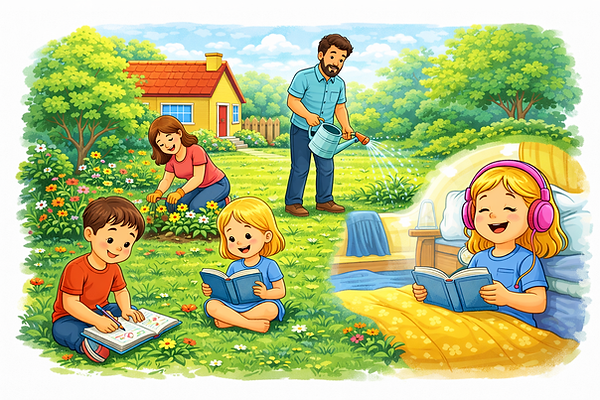
A Saturday Together
On Saturday morning, I wake up a little late.
My sister Emma wakes up later than me.
She smiles and says, “Good morning!”
We go to the kitchen together.
I drink milk, and Emma drinks tea.
We eat toast and talk about our week.
After breakfast, Emma reads a story.
I draw in my notebook.
Sometimes we play a game together.
In the afternoon, our parents work in the garden.
They plant flowers and water the grass.
We help them and laugh a lot.
In the evening, I watch a cartoon.
Emma listens to music.
We go to bed happy.
--------------------------------------------------
A. Răspunde la întrebări despre text.
1. Who wakes up first?
→ ______________
2. What do they eat for breakfast?
→ ______________
3. What does Emma do after breakfast?
→ ______________
4. What do the parents do in the afternoon?
→ ______________
5. Are they happy in the evening?
→ ______________
--------------------------------------------------
B. How about you?
1. When do you wake up on Saturday?
→ ______________
2. What do you drink in the morning?
→ ______________
3. What do you do after breakfast?
→ ______________
4. Do you help your parents?
→ ______________
5. Are you happy on Saturday?
→ ______________
--------------------------------------------------
C. Scrie 5 propoziții despre tine.
On Saturday, I __________.
I ______________.
My family ____________.
We ______________.
I feel _____________.